We'll cover the full campaign lifecycle from concept to post-campaign repurposing, with real examples, budget allocation frameworks, and industry-specific templates. For the technical side of displaying hashtag feeds once your campaign is running, see our Instagram Hashtag Feed guide, and for getting an Instagram feed onto the site in the first place, how to embed an Instagram feed on your website. For the strategic principles behind why campaigns work, see our UGC Campaign Strategy guide. This article focuses on execution: what to do, when to do it, and how to measure results.
Phase 1: Campaign Planning & Goal Setting
Successful campaigns start with clear objectives. Not "we want more engagement" but "we want 500 customer photos we can use on product pages" or "we want to increase brand awareness among 18-25 year olds by 15%." Measurable, specific goals drive every other decision—hashtag selection, prize structure, amplification strategy.
Campaign Goal Types
Brand awareness: Goal is reach and impressions. You want your hashtag and brand name seen by as many people as possible. This drives hashtag selection (broad appeal) and prize structure (large, shareable prizes that encourage viral participation). Success metrics: total hashtag impressions, reach, share of voice in your category.
Lead generation: Goal is collecting contact information or driving website traffic. Campaign mechanics require email signup or website visit as part of entry. Prize structure emphasizes exclusivity or scarcity to drive action. Success metrics: leads collected, cost per lead, website sessions from campaign traffic.
User-generated content collection: Goal is acquiring high-quality photos, videos, or testimonials you can use in marketing. Campaign mechanics emphasize content quality over volume. Prize structure may include "feature" as a reward (your content displayed on our website, social accounts, or in ads). Success metrics: number of usable assets collected, content quality score, rights obtained.
Sales and conversions: Goal is direct revenue. Campaign includes product purchase incentive (discount codes, free shipping) or requires proof of purchase to enter. Prize structure includes high-value product bundles or shopping sprees. Success metrics: sales attributed to campaign, revenue, ROI.
Community building: Goal is deepening relationships with existing customers. Campaign is exclusive to current customers or loyalty program members. Prize structure emphasizes experiences over products— VIP events, early access, meet-and-greets. Success metrics: repeat participation rate, customer lifetime value increase, community sentiment.
Budget Allocation Framework
According to contest strategy research, it's recommended to allocate 10-20% of your marketing budget for contest prizes and promotion. Here's how to break that down:
- 40-50% on prizes: The actual value participants win. This includes product value, cash prizes, experiences, or brand swag.
- 25-35% on paid amplification: Social media ads promoting the campaign, influencer fees for seeding participation, email campaign costs.
- 15-25% on tools and infrastructure: Hashtag tracking software, rights management tools, moderation platform, website display widget.
- 10-15% on creative and content: Campaign assets— announcement graphics, video promos, email templates, influencer brief materials.
For a $10,000 campaign budget, that translates to roughly $4,500 in prizes, $3,000 in paid promotion, $2,000 in tools, and $500 in creative. Adjust based on your goals—if you're optimizing for volume, shift more to paid amplification; if you're optimizing for content quality, shift more to prizes and influencer seeding.
Campaign Timeline Planning
Most hashtag campaigns run 2-6 weeks. Shorter campaigns (1-2 weeks) create urgency but limit total participation. Longer campaigns (6+ weeks) allow more time for organic growth but risk losing momentum. The ideal duration depends on campaign complexity and how fast you can amplify.
Here's a standard 4-week campaign timeline:
- Week -2 (Pre-launch): Finalize hashtag, create campaign assets, brief influencers, set up tracking and display tools, seed initial content with brand and influencer accounts.
- Week 1 (Launch): Public announcement, paid social promotion begins, influencers post, email blast to customers, monitor and moderate submissions, engage with early participants.
- Weeks 2-3 (Growth): Continue paid promotion, feature top submissions on your social accounts and website, send reminder emails, optimize based on what's working.
- Week 4 (Final push): "Last chance" messaging, highlight total participation numbers to create FOMO, announce winners at campaign close.
Phase 2: Hashtag Selection Science
Your hashtag is the infrastructure that connects participant posts to your campaign. A well-chosen hashtag is memorable, unique, and strategically aligned with your goals. A poorly chosen hashtag gets misspelled, confused with unrelated content, or simply not used.
The Three-Part Test for Hashtag Viability
Before committing to a campaign hashtag, test it against these three criteria:
1. Memorability test: Can someone hear your hashtag once and remember it 10 minutes later? Say it out loud. Is it catchy? Does it roll off the tongue? Complex, multi-word hashtags with unclear capitalization (#MyBrandSpringCampaign2026) fail this test. Simple, punchy hashtags (#ShareACoke, #JustDoIt) pass.
2. Uniqueness test: Search your hashtag on Instagram, TikTok, and Twitter. Is it already being used? If yes, for what? If your hashtag is already associated with unrelated content, you'll have noise in your feed that requires constant moderation. A unique branded hashtag—ideally one with zero or minimal existing usage—gives you a clean slate.
3. Trademark and legal test: Search USPTO (United States Patent and Trademark Office) and equivalent trademark databases in your markets to ensure your hashtag isn't trademarked by another brand. Using a trademarked phrase can create legal risk, especially if your campaign gains traction. While hashtags themselves can't be trademarked in isolation, using a trademarked brand name or slogan in a hashtag can infringe on existing rights.
Campaign Hashtag vs Evergreen Hashtag Strategy
Many successful brands run both types:
Campaign hashtags are time-limited. Coca-Cola's #ShareACoke, Starbucks' #RedCupContest, GoPro's seasonal challenges. These hashtags launch, grow rapidly during the campaign period, and then retire. They're associated with specific promotions, prizes, or events.
Evergreen hashtags are always active. Nike's #JustDoIt, Airbnb's #AirbnbExperiences, Lululemon's #TheSweatLife. These hashtags continuously collect user content as customers engage with the brand. No start date, no end date, no specific prize—just ongoing community participation.
The strategic difference: campaign hashtags drive bursts of participation and content volume. Evergreen hashtags build long-term community and provide continuous content flow. Most brands benefit from one evergreen hashtag plus periodic campaign hashtags tied to product launches, seasons, or promotional events.
Multi-Lingual Hashtag Considerations
If you operate in multiple countries or serve multilingual audiences, consider how your hashtag translates. Does it work in Spanish? French? Mandarin? Some brands create localized hashtag variations (#ShareACokeUS, #ComparteUnaCoca). Others use English hashtags globally, which works if your brand is internationally recognized and English is understood by your target demographic.
The campaign growth cycle
This animation shows how a hashtag campaign builds momentum: influencers seed initial content, their followers see the hashtag and participate, participation drives social proof that attracts more participants, and the cycle compounds. Each wave of content makes the next one easier to generate.
Phase 3: Participant Incentivization
People participate in hashtag campaigns when the personal benefit— winning something, getting featured, expressing themselves, joining a community—exceeds the cost of time, effort, and social risk. Your job is to design incentives that maximize perceived benefit and minimize perceived cost.
Prize Structure Design
According to UGC contest research, tiered prize structures work best: 1 grand prize, 5 category winners, and 50 honorable mentions with discount codes. This structure gives participants multiple ways to win, which increases the perceived likelihood of winning and drives higher participation.
Prize types by goal:
- Cash prizes drive volume but attract contest-chasers who have no genuine brand affinity. Best for awareness campaigns where you want maximum reach and don't care if participants become customers.
- Product prizes attract people who actually want your product, which means higher-quality submissions and higher likelihood of converting participants into customers. Best for UGC collection and sales goals.
- Experience prizes (VIP event access, meet-and-greet with brand ambassador, exclusive preview) attract passionate fans. Submissions tend to be more authentic and emotionally invested. Best for community building and storytelling campaigns.
- Feature/recognition prizes (your content displayed on our website, Instagram account, or in ads) cost nothing but are highly motivating for creators and micro-influencers. Best for low-budget campaigns targeting aspiring content creators.
The "Everyone Wins" Model
An underutilized strategy: give every participant something. A 10% discount code, free shipping, a digital wallpaper, entry into a giveaway. This dramatically increases participation because the benefit is guaranteed, not probabilistic. The downside: cost scales with participation. The upside: you can use the benefit as a lead magnet (email required to receive discount code), which turns campaign participants into leads.
Gamification Elements
Advanced campaigns add gamification to increase engagement beyond initial submission:
- Leaderboards: Display top contributors based on number of submissions, likes received, or creativity score. Creates competitive motivation and encourages multiple submissions from engaged participants.
- Badges and levels: Award badges for milestones (first submission, 5 submissions, 10 submissions). Display these on a campaign landing page. Taps into collection psychology and status signaling.
- Daily challenges: Each day of the campaign, post a new prompt or theme. Keeps campaign fresh and gives participants ongoing reasons to post. Works especially well for 2-4 week campaigns that need sustained participation.
Phase 4: Campaign Amplification
Even the best-designed campaign fails if nobody knows about it. Amplification is how you drive awareness and participation. The most effective campaigns use multi-channel amplification: influencer seeding, paid social promotion, email marketing, and organic social posting.
Influencer Seeding Strategy
Influencers serve two functions in hashtag campaigns: they provide initial content that shows others what "good" looks like, and they amplify the campaign to their followers. Most successful campaigns don't launch cold—they seed participation with 3-10 influencers or brand ambassadors who post on day 1 or in the week leading up to launch.
How to structure influencer partnerships for campaigns:
Micro-influencers (1K-100K followers): Lower cost, higher authenticity. For a hashtag campaign, expect to pay $100-$1,000 per post depending on follower count and engagement rate. Brief them to use the campaign hashtag, explain why they're participating, and encourage their followers to join. Micro-influencers often drive higher participation per dollar spent than macro-influencers because their audiences are more engaged and trust their recommendations.
Macro-influencers (100K-1M followers): Higher cost, broader reach. Expect $1,000-$10,000+ per post. Best used for awareness campaigns where reach matters more than engagement depth. One macro-influencer post can generate hundreds of campaign submissions if their audience aligns with your target demographic.
Brand ambassadors and existing customers: Your most cost- effective amplification. Reach out to loyal customers, loyalty program members, or existing brand advocates and invite them to participate early. Offer them early access to prizes or exclusive perks for posting. They have smaller followings than professional influencers but higher trust with their networks.
Paid Social Promotion
Organic reach on social platforms is limited. To reach beyond your existing followers, allocate budget to paid promotion. Platform-specific strategies:
Instagram and Facebook Ads: Create carousel ads showcasing top campaign submissions (once you have them) or a video announcing the campaign. Target lookalike audiences based on your best customers or page followers. Direct users to a campaign landing page or your Instagram profile where campaign details live. Budget $500-$5,000 depending on campaign size and goals.
TikTok Promote and Spark Ads: For TikTok hashtag challenges, use Spark Ads to boost your brand's campaign announcement video or top user submissions. TikTok's algorithm favors video content, so budget more heavily here if your target demographic is Gen Z or younger Millennials. Per TikTok's own case study, Wet n Wild's mascara campaign generated 1.5 million user-created videos and achieved a 13.7% TopView engagement rate by using TopView ads combined with creator partnerships.
YouTube and Pinterest Ads: Less common for hashtag campaigns but effective for specific product categories. YouTube pre-roll ads work well for campaigns requiring video submissions (show examples of what you're looking for). Pinterest promoted pins work for home, fashion, beauty, and food brands where visual inspiration drives action.
Email Marketing Integration
Your email list is owned media—use it. Send a dedicated campaign announcement email to your full list. Segment by engagement level: highly engaged customers get early access or exclusive perks, general list gets the main announcement.
Email templates for campaigns:
- Launch announcement (Week 1): "Join Our #[Hashtag] Campaign & Win [Prize]" — explain campaign, show how to enter, highlight prize, include strong visual CTA.
- Reminder email (Week 2): "You Could Win [Prize] — Join [X] Customers Already Participating" — use social proof (number of submissions), feature top entries, reinforce deadline.
- Final push email (Week 4): "Last Chance to Enter: Campaign Ends [Date]" — urgency-driven, showcase total participation numbers, final reminder of prize value.
Cross-Platform Promotion
Don't confine your campaign to one platform. If you launch on Instagram, also promote on TikTok, Twitter, Facebook, LinkedIn (for B2B brands), and your website. According to hashtag marketing research, cross-platform campaigns see significantly higher total participation because different demographics use different platforms. Your Instagram followers might be 25-40 year old women; your TikTok followers might be 16-25 year olds. Running the same campaign across both platforms lets you tap both audiences.
Phase 5: Real-Time Moderation & Engagement
Once your campaign launches, moderation becomes critical. Not every submission will be on-brand or appropriate for display on your website. You need a moderation workflow that approves quality content, filters inappropriate content, and engages with participants to encourage more submissions.
Moderation Workflow
Step 1: Automated filtering. A hashtag campaign pulls in public posts from people you've never met, so your first line of defense should be automatic. In CollectSocials this runs on three layers you can stack: a keyword blocklist that drops posts containing profanity, competitor names, or spam terms; AI text moderation that reads captions for unsafe or off-brand language; and — the part most tools quietly skip — AI image (vision) moderation that actually looks at the photo or video frame and flags unsafe visuals before they can ever reach your site (available on Business plans and up).
On a public hashtag feed, that image layer matters more than anything else. A single inappropriate photo slipping onto a live campaign wall or an event screen is the precise failure you're trying to prevent, and text-only filtering cannot catch it — the caption can be perfectly clean while the image is not. When we tested the leading UGC platforms for a recent writeup, this was the consistent gap: they moderate text and captions, but not the images themselves. It's worth confirming any tool you rely on closes it before you point a live display at a public hashtag.
Step 2: Manual review queue. All remaining submissions go to a moderation dashboard where your team reviews and approves/rejects. Criteria: Is this on-brand? Is the content quality sufficient? Is the person's account legitimate (not a bot or spam account)? Does this align with our campaign goals?
Step 3: Rights acquisition. For content you want to use beyond a website feed — in ads, emails, or on product pages — get explicit permission, and keep a record of it that will actually hold up if someone later challenges it. Don't settle for a "yes" buried in a comment thread the creator can delete: ask on neutral ground, show them the terms they're agreeing to, and store the approval as a durable, per-post record with a real withdrawal path. We pushed the popular comment-based approach to its breaking point — approving a request, then deleting our own consent to watch what the "audit trail" did — and wrote up what a defensible consent record actually needs in I tested a UGC rights tool, then deleted my own consent.
Moderation Team Staffing
How much moderation capacity do you need? It depends on campaign volume:
- Small campaigns (<100 submissions expected): One person checking moderation queue 1-2 times daily is sufficient.
- Medium campaigns (100-1,000 submissions): One person dedicated to moderation, checking multiple times daily, responding to questions, engaging with participants.
- Large campaigns (1,000+ submissions): Team of 2-3 moderators working in shifts to ensure fast approval times. Response time matters—participants who see their content approved and displayed quickly are more likely to post again.
Engagement Tactics
Moderation isn't just filtering—it's engagement. The brands that get the most from campaigns actively engage with participants:
- Like and comment on submissions. When someone posts with your hashtag, like their post and leave a comment ("Love this! Thanks for participating!"). This takes seconds per post but creates a personal connection and encourages repeat participation.
- Feature top submissions on your brand account. Repost the best content to your Instagram Stories, feed, or TikTok. Tag the creator and thank them publicly. This is the "recognition prize" that costs nothing but is highly motivating.
- Update your website feed in real-time. As you approve submissions in your moderation dashboard, they should appear on your website hashtag feed immediately. This creates a live, dynamic display that shows campaign momentum and encourages fence-sitters to join.
sync
From submission to website display
The animation shows the path a campaign submission takes: a participant posts with your hashtag, it enters your moderation queue, you approve it, and it appears on your campaign landing page or product page within minutes. This real-time display creates visible momentum that encourages more participation.
Phase 6: Displaying Campaign Results on Your Website
The campaign content you collect isn't just for social media—it's social proof you can display on your website to drive conversions. Here's how to maximize the value of hashtag campaign content on your site.
Where to Display Campaign Feeds
Dedicated campaign landing page: Create a page specifically for the campaign (/campaign/[hashtag-name]) that explains the campaign, shows how to enter, displays prizes, and features a live feed of all approved submissions. This page is what you link to from ads, emails, and social posts. It becomes the central hub for campaign activity.
Homepage community section: Add a section to your homepage titled "Join Our Community" or "See What Our Customers Are Creating" with a carousel feed of top campaign submissions. This provides social proof to all website visitors and drives awareness of the campaign.
Product pages: If your campaign is product-specific (e.g., "Show us how you style our summer dress"), display campaign content on relevant product pages. Seeing real customers using the product builds purchase confidence.
Post-purchase thank-you page: After someone buys, show them campaign content and invite them to participate: "Join [X] customers who've already shared their [product] experience." This converts new customers into campaign participants.
Design & Layout Recommendations
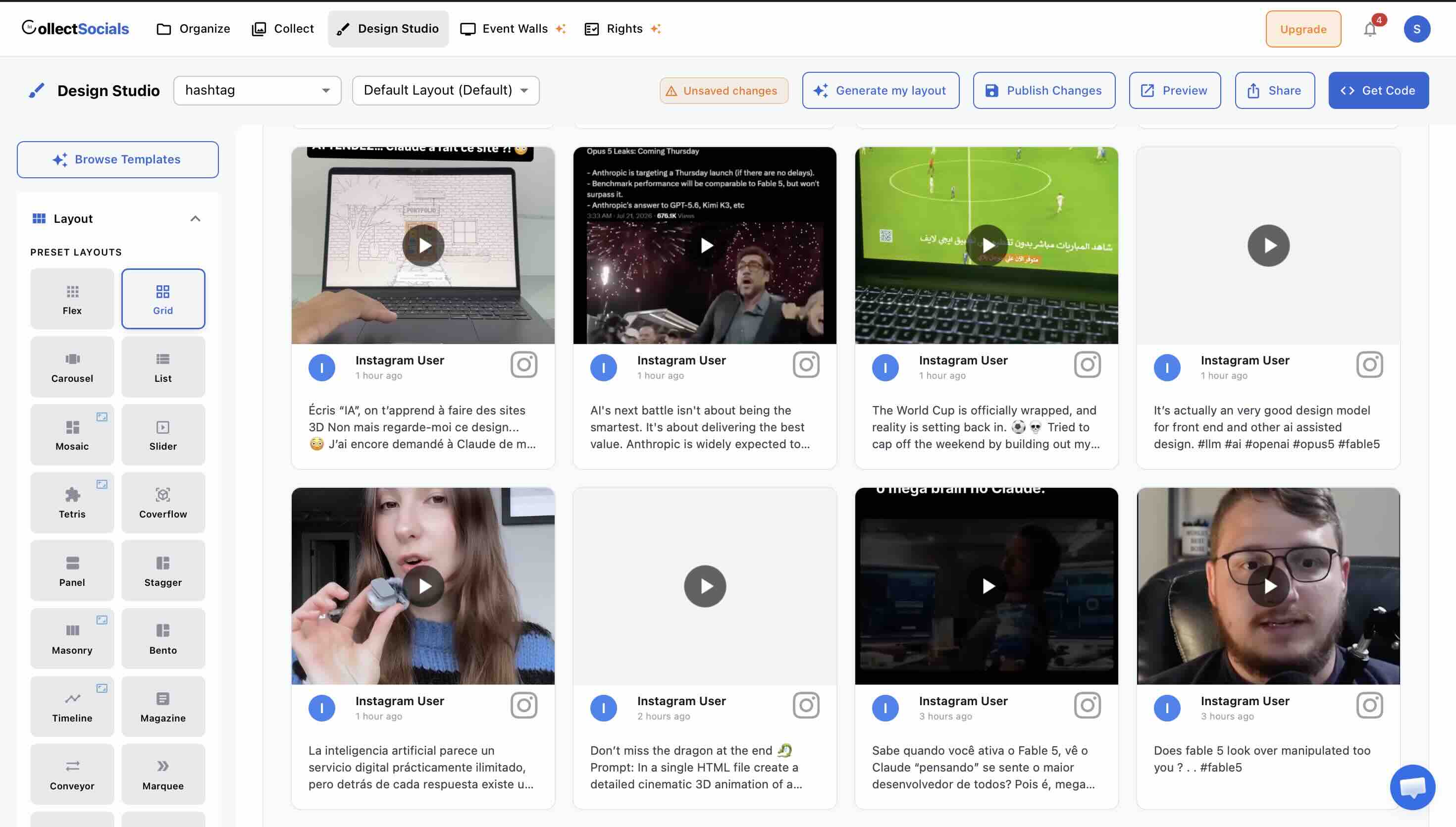
For campaign feeds, visual impact matters. Use layouts that showcase content prominently:
- Masonry layout: Best for mixing photos and videos of varying dimensions. Creates an editorial, curated feel. Works well on dedicated campaign pages where the feed is the primary content.
- Grid layout: Best for consistency and visual rhythm. All content displayed in uniform squares. Works well on homepages where the feed is part of a larger page design.
- Carousel layout: Best for limited space (sidebars, sections within longer pages). Shows 3-5 items at a time, users swipe or click arrows to see more.
Post-Campaign Strategy: Permanent Gallery
After your campaign ends, don't delete the content. Archive it as a permanent gallery that continues to provide social proof. Transform your campaign landing page into a "Community Gallery" or "Customer Showcase" page featuring the best submissions from your campaign. This content has ongoing value—it shows new visitors that your brand has an engaged community and real customers who love your products.
Update the page copy to remove campaign-specific language ("Enter by May 31") and replace with evergreen messaging ("See how our customers use [product]" or "Join our community"). Keep the hashtag feed active so any new posts using your hashtag continue to appear.
Real Campaign Case Studies with Metrics
Here's what successful hashtag campaigns look like in practice, with actual performance data:
Case Study 1: Wet n Wild x JVKE Mascara Launch
Goal: Brand awareness and product launch buzz for new mascara product. Target demographic: Gen Z beauty consumers on TikTok.
Strategy: Partnered with artist JVKE to create custom campaign audio, then collaborated with Bella Poarch and other top TikTok creators to launch a branded hashtag challenge. Encouraged users to create videos showing dramatic mascara application with the custom audio.
Results: Per TikTok's published case study, the campaign generated 1.5 million user-created videos, achieved a 13.7% TopView engagement rate (significantly above TikTok's average ~3-5%), and drove a 9.6% increase in brand awareness measured through brand lift studies.
Takeaway: Audio-driven TikTok challenges combined with top-tier creator partnerships can generate massive participation. The key was making participation easy (film yourself applying mascara to trending audio) and seeding with trusted creators who demonstrated what "good" looked like.
Case Study 2: Oreo's #OreoTwist Campaign
Goal: Sustained brand engagement and UGC collection across TikTok and Instagram. Target: broad consumer base, all ages.
Strategy: Launched a multi-platform campaign asking users to show creative ways they "twist" their Oreos before eating. Simple mechanic, broad appeal, no purchase required. Partnered with food creators to seed initial content.
Results: The hashtag drove sustained multi-platform participation, with creator-seeded videos carrying the twist mechanic across TikTok and Instagram Reels. Mondelez has not published campaign-level view counts or sales figures, so treat the widely-circulated numbers for this campaign with caution — the strategic lesson below holds regardless.
Takeaway: Simplicity wins. The campaign didn't require elaborate production, just a phone and an Oreo. This low barrier to participation drove massive volume. Cross-platform approach captured multiple demographics (younger on TikTok, broader on Instagram).
Case Study 3: Starbucks #RedCupContest
Goal: Seasonal engagement during holiday period, UGC collection for holiday marketing, drive in-store traffic.
Strategy: Annual contest asking customers to creatively decorate or photograph their red Starbucks holiday cups and share with #RedCupContest. Prizes include Starbucks gift cards and merchandise. Campaign runs 2-3 weeks during peak holiday shopping season.
Results: While Starbucks doesn't publicly disclose precise metrics, independent social listening analysis shows the hashtag generates 100,000+ posts annually, with content continuing to accumulate after official campaign ends as customers organically use the hashtag each holiday season. Starbucks repurposes top submissions in holiday advertising and store displays.
Takeaway: Seasonal campaign hashtags can become annual traditions. The #RedCupContest has run for multiple years, building anticipation and making participation feel like a holiday ritual. Customers now expect and look forward to the campaign, which reduces the need for heavy promotion in subsequent years.
Case Study 4: GoPro User-Generated Content Campaigns
Goal: Continuous UGC collection showcasing product capabilities, community building among action sports enthusiasts.
Strategy: Evergreen hashtag strategy (#GoPro, #GoProTravel, etc.) combined with periodic themed challenges ("Photo of the Day," "Million Dollar Challenge"). No end date for main hashtags— always active. Periodic campaigns offer cash prizes for best submissions, which become GoPro advertising content.
Results: GoPro's hashtags have accumulated millions of posts across Instagram, YouTube, and TikTok. The brand rarely creates its own advertising content—nearly all marketing materials are user-submitted. This reduces production costs while providing authentic proof of product capabilities. GoPro's "Million Dollar Challenge" campaigns receive 25,000+ video submissions per year.
Takeaway: For product categories where demonstration matters (cameras, outdoor gear, travel products), evergreen UGC campaigns provide continuous content flow AND serve as product proof. The content collected isn't just marketing—it's sales collateral showing real product use.
Industry-Specific Campaign Ideas
Different industries have different natural campaign angles. Here's what works well by vertical:
Restaurants & Hospitality
Food photo contests: Ask customers to share photos of their favorite menu item. Prize: free meal, gift card, or catering for a party. Display top submissions on menu boards, website menu pages, and social accounts.
"Create your own" campaigns: Let customers design their ideal dish, cocktail, or dessert using your ingredients. Winner gets their creation added to the menu. This drives engagement and provides menu innovation insights.
According to restaurant social media research, the "everyone wins" model works exceptionally well for restaurants: every participant gets a free appetizer or side on their next visit. This drives repeat visits and foot traffic while generating content.
Fashion & Beauty
Styling challenges: "Show us how you style [product]" campaigns. Customers share outfit photos featuring your clothing or beauty looks using your products. Winners get featured on your Instagram and website.
Try-on hauls: Encourage unboxing and try-on videos (popular on TikTok and Instagram Reels). This provides authentic product reviews and demonstrates fit, color accuracy, and styling options that studio photography can't convey.
Fitness & Wellness
Transformation campaigns: Ask customers to share before/after photos, progress stories, or workout videos using your app, equipment, or program. Prize: free year of service, product bundle, or feature in marketing materials.
Challenge campaigns: 30-day fitness challenges, healthy eating challenges, mindfulness challenges. Daily prompts keep engagement high throughout campaign duration. Leaderboards and badges add gamification.
Retail & E-commerce
Unboxing campaigns: Encourage customers to share unboxing videos or photos of their recent purchase. This provides social proof of product quality, packaging, and customer excitement.
Product review campaigns: Incentivize detailed product reviews (photo or video + written review). Prize: store credit, exclusive early access to new products, or VIP customer status.
B2B & Professional Services
Customer success story campaigns: Ask customers to share how your product or service solved a business problem. Prize: feature in case study, invitation to speak at company webinar, or free consulting hours.
Industry insight campaigns: Encourage professionals in your industry to share tips, trends, or predictions using your branded hashtag. This builds thought leadership by association and creates community among your customer base. For more on B2B strategies, see our LinkedIn Feed for Business guide.
Post-Campaign Content Repurposing
The content you collect during campaigns has value far beyond the campaign period. Here's how to extract maximum value:
Advertising Creative
Use top campaign submissions (with permission) in social media ads, display ads, and video ads. UGC in ads typically outperforms brand-created content because it looks more authentic and relatable. Test UGC ads against studio- shot ads and measure performance difference.
Email Marketing Content
Feature campaign content in email newsletters: "See what our community created this month" or "Customer spotlight." This provides social proof in email and keeps campaigns top-of-mind even after they end.
Product Page Social Proof
The best product-specific campaign content should be permanently displayed on relevant product pages. Customer photos of your product in real-world use are more persuasive than studio photography. See our E-commerce Social Proof guide for placement strategies.
Future Campaign Inspiration
Analyze which submissions got the most likes, shares, and engagement during your campaign. These are your blueprint for future campaigns—they show what your audience responds to. If video tutorials got 10x the engagement of static photos, your next campaign should emphasize video content.
Measuring Campaign Success
How do you know if your campaign worked? Track these metrics:
Volume Metrics
- Total submissions: Number of unique posts using your campaign hashtag. This is your primary participation metric.
- Total participants: Number of unique accounts that posted (different from total submissions—some users post multiple times).
- Platform breakdown: How many submissions came from Instagram vs TikTok vs Twitter vs other platforms. Helps inform future campaign platform strategy.
Reach & Engagement Metrics
- Total impressions: How many times posts with your hashtag were viewed. Aggregated across all platforms and all participants. According to hashtag metrics research, this is a key measure of brand awareness impact.
- Total engagement: Likes, comments, shares, saves across all campaign posts. High engagement indicates content resonance.
- Share of voice: How much conversation about your brand vs competitors during campaign period. Measure using social listening tools like Brand24, Brandwatch, or Sprout Social.
Business Impact Metrics
- Website traffic from campaign: Use UTM parameters on campaign links to track sessions, pageviews, and conversions originating from campaign traffic.
- Leads generated: If campaign required email signup, how many leads collected? What's the cost per lead compared to other channels?
- Sales attributed to campaign: Use discount codes or campaign-specific product links to track direct sales. For broader brand awareness campaigns, compare sales during campaign period to equivalent period previous year (controlling for seasonality).
- ROI: (Campaign Revenue - Campaign Cost) / Campaign Cost × 100 = ROI%. A successful campaign should deliver 200-500% ROI when accounting for both direct sales and longer-term brand value.
Content Value Metrics
- Usable assets collected: How many submissions are high-quality enough to use in marketing? This is your UGC library value.
- Rights obtained: Of usable assets, how many did you secure permission to use beyond website display? These have higher value because you can use them in ads, emails, and other channels.
- Advertising Value Equivalent (AVE): How much would you have spent on ads to generate the same exposure your campaign achieved organically? This metric shows the earned media value of your campaign.
Designing your campaign gallery
The animation shows layout and theme options for displaying campaign submissions: masonry for visual impact on dedicated landing pages, grid for homepage social proof sections, and carousel for product pages where space is limited. The design should celebrate participant creativity while maintaining brand consistency.
The Bottom Line
Hashtag campaigns are not luck—they're design. The campaigns that generate thousands of submissions and measurable business results are built on clear goals, strategic incentive structures, multi-channel amplification, and real-time engagement. Most brands launch campaigns and hope for the best. The brands that win plan systematically, execute precisely, and optimize continuously.
Start with one campaign. Set a specific, measurable goal. Design your hashtag using the three-part test. Structure prizes to align with your goal. Seed participation with influencers or brand ambassadors. Amplify through paid and organic channels. Moderate in real-time and engage with participants. Display results on your website as ongoing social proof. Measure everything. Learn from what worked and what didn't. Then run another campaign, better than the first.
The brands with the strongest communities and the most authentic social proof didn't get there by accident. They built systematic processes for turning customers into content creators, and campaigns into ongoing marketing assets. You can do the same.
If the campaign is anchored to a live event, the hashtag is only half of it: the other half is the screen in the room, and the people there who will post a photo but do not use the hashtag or hold a public account. Our social wall for events page covers that side, including posting straight to the wall with no account at all.
Campaign tags run by charities and community groups carry an extra problem, which is that the people in the photographs are often the people the organisation serves. Our feeds for nonprofits and charities page covers running a public tag alongside recorded consent that a supporter can withdraw later.
Start Using CollectSocials Today
One curated feed from 10+ platforms: on your website in a single line of code, or up on the big screen at your event.