
Most Juicer pricing articles online either quote outdated plan names (the old Small/Medium/Large structure was replaced), skip the Enterprise billing model entirely, or miss the platform restrictions that apply to lower tiers. This guide covers all of it.
Juicer.io Plans and Pricing at a Glance (2026)
Juicer currently offers five plan tiers, from a permanent free plan up to Enterprise, plus two specialised options covering events and standalone landing pages. Here is the complete breakdown:
| Plan | Price | Sources | Views/mo | Refresh Rate | Branding |
|---|---|---|---|---|---|
| Free | $0/mo | 1 | 300 | 24 hours | Juicer branding shown |
| Lite | $15/mo | 3 | 5,000 | 60 minutes | No branding |
| Starter | $25/mo | 5 | 20,000 | 60 minutes | No branding |
| Pro | $99/mo | 30 | 100,000 | 10 minutes | No branding |
| Enterprise | $199/mo minimum | Up to 50 | Unlimited | 10 minutes | No branding + white-label |
Note: All plans include unlimited website embeds: you can place the same feed on as many pages as you want. The "Sources" column is the number of unique social accounts or hashtags you can connect.
Note: when we tested in May 2026, LinkedIn and X/Twitter sources were available only during the initial 7-day trial on Lite, Starter and Pro, with ongoing access requiring an Enterprise subscription. Juicer's pricing page does not state this next to either platform, so confirm both against their live pricing before you plan a feed around them.
Annual billing reduces prices by approximately 10 percent on eligible plans.
The Free Plan: What You Actually Get
We signed up for Juicer's free plan to verify the limitations firsthand rather than rely on marketing page descriptions. Here is what we found.
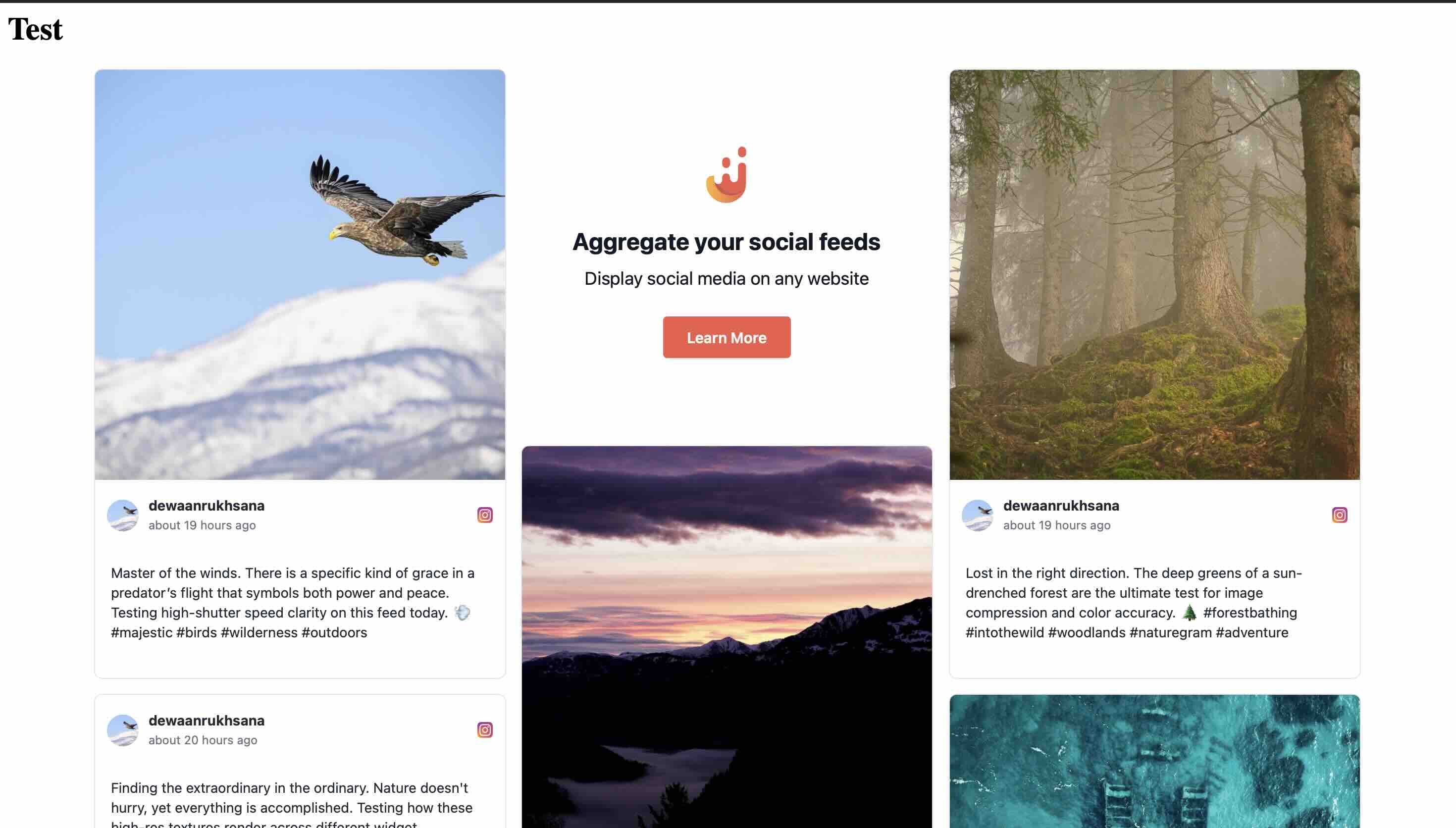
The free plan gives you one social media source with unlimited website embeds that update once every 24 hours. Your feed displays Juicer's branding, a prominent logo and promotional panel shown inside the feed itself, visible to every visitor.
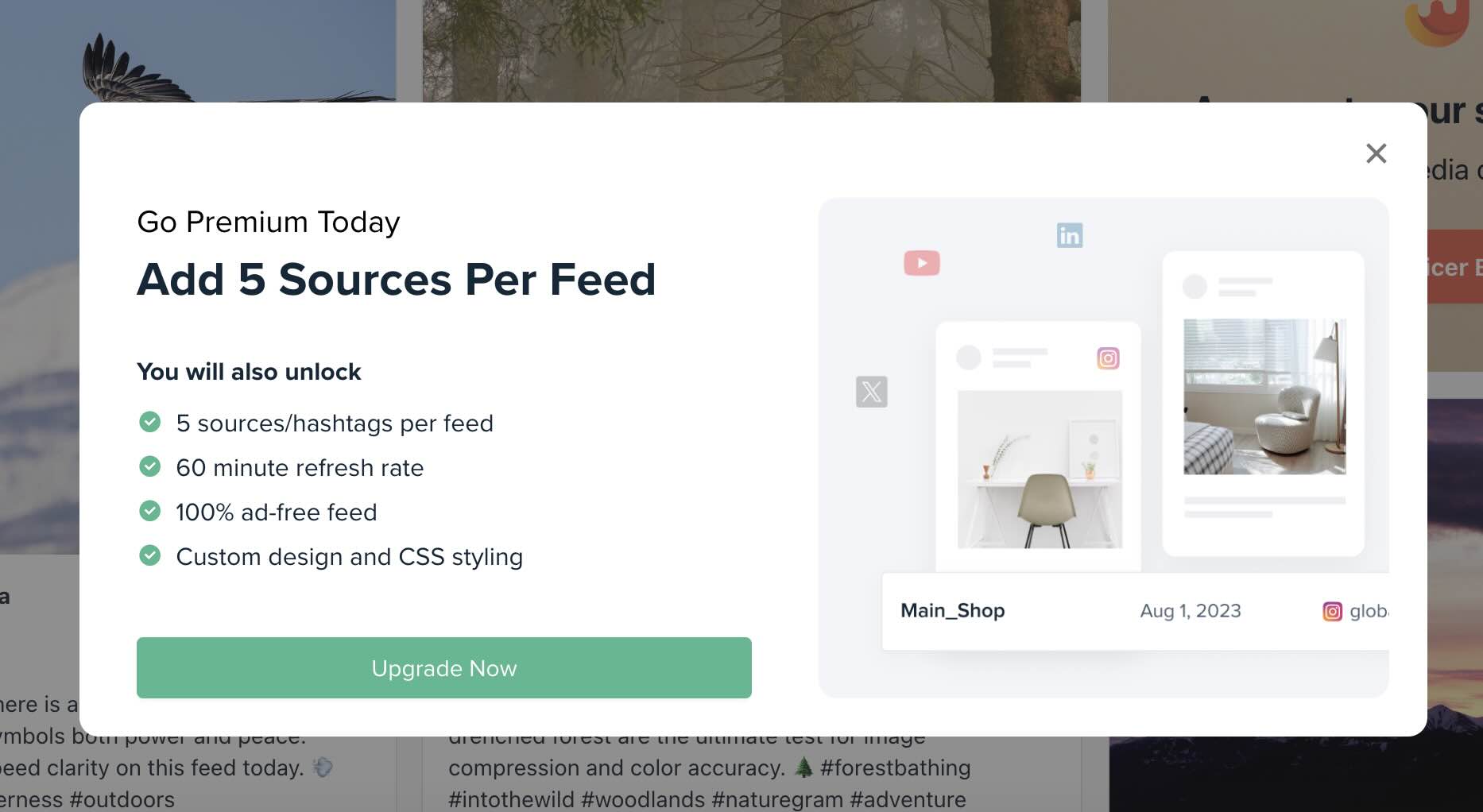
The single-source limit is strict. When we attempted to add a second source, even just a hashtag feed, a modal blocked us from proceeding and pushed an upgrade offering five sources per feed and a 60-minute refresh, which is the Starter tier rather than the cheaper Lite one. While you get unlimited website embeds (you can place the same feed on multiple pages), you cannot create different feeds with different content since you only have one source.
The 24-hour refresh rate is the most meaningful limitation for businesses. If you post to Instagram on Monday morning, that post may not appear in your website feed until Tuesday. For a live business where social activity is part of your customer experience, this delay erodes the value of having a social feed at all.
Who the free plan actually works for: Personal blogs, test environments, and developers evaluating the embed mechanics before committing. For any business-facing website, the restrictions make it too limited to serve as a genuine product.
The Lite Plan ($15/mo): Removes Branding, Adds Hourly Refresh
The Lite plan removes Juicer's branding from your feed and increases your source count from 1 to 3. More importantly, it upgrades the refresh rate from 24 hours to 60 minutes, a significant improvement for businesses posting regularly.
The hourly refresh rate makes the feed feel much more current. If you post to Instagram at 10am, your website feed will update by 11am. For businesses that post a few times per week, this is functional, though not real-time.
At $5 per source per month, the Lite plan is reasonably priced. The 5,000 monthly view limit is sufficient for small business websites with moderate traffic. Like all Juicer plans, you get unlimited website embeds, you can place the same feed on multiple pages.
Who the Lite plan works for: Small businesses that want a clean, branding-free social feed showing up to three accounts, with hourly updates. A restaurant showing its Instagram, Facebook, and Google Reviews would fit well here, assuming none of those sources are LinkedIn or X/Twitter (which require Enterprise after the 7-day trial).
The Starter Plan ($25/mo): The Real Entry Point for Most Businesses
This is where most SMBs and growing businesses will land when they first upgrade from free. The Starter plan gives you five sources, unlimited website embeds, and an hourly refresh rate. Juicer's branding is removed. You get basic custom CSS access and the ability to add call-to-action buttons to posts.
Five sources covers the typical brand social footprint: Instagram, Facebook, YouTube, TikTok, and one hashtag feed. The 20,000 monthly view limit is adequate for most small business websites. That is a reasonable set for most small businesses.
The hourly refresh rate is functional for brands that post a few times per week. It will not feel real-time during an active campaign, but for evergreen social content displayed on a homepage, one hour is workable.
The critical limitation here that almost no review mentions: LinkedIn and X/Twitter are only available during Juicer's initial 7-day trial on the Starter plan. After the trial ends, those two platforms are restricted to Enterprise subscribers only. If you are a B2B company whose primary social channels are LinkedIn and X/Twitter, the Starter plan effectively does not support your use case at all after the first week.
This is exactly the kind of detail that does not survive a pricing-page skim. The plan columns list LinkedIn and X/Twitter among the available platforms; the trial-only restriction is not stated next to either of them. Discovering it after you have published a social feed to your website, and then watching those sources stop updating, is a frustrating experience.
Unlimited embeds with combined sources. While you can place the feed on as many pages as you want, all five sources feed into the same combined stream. If you want your homepage to show Instagram posts and your about page to show only Google Reviews, you would need to manage that through filtering and moderation settings rather than separate feeds.
Who the Starter plan works for: Small businesses whose primary social channels are Instagram, Facebook, YouTube, and TikTok; who need unlimited embed placements showing the same combined feed; and who do not rely heavily on LinkedIn or X/Twitter for brand presence.
The Pro Plan ($99/mo): The Multi-Source Option With a Hidden Ceiling
The Pro plan is a significant jump from Starter in both capability and price. You get 30 sources with unlimited website embeds, a 10-minute refresh rate, analytics, and full custom CSS. The 10-minute refresh is a meaningful upgrade for businesses with active social accounts or running live campaigns.
The jump from $25 to $99 per month is steep, nearly a 4x increase. And there is nothing in between. If you need 8 sources instead of 5, you still pay $99. If you need 12 sources, you still pay $99. The jump from Starter to Pro is binary, and for businesses that fall in the 6-to-15 source range, the pricing gap feels disproportionate to the added value.
Like all Juicer plans, Pro includes unlimited website embeds, you can place your feeds on as many pages as you want. However, all 30 sources feed into the same combined stream. If you want different embed placements showing different source combinations (e.g., Instagram-only on the homepage, YouTube-only on a resources page), you would need to manage that through filtering and moderation settings rather than creating separate feeds.
Analytics are included but remain basic. Pro plan analytics give you post-level metrics (impressions, clicks, engagement) but do not include conversion attribution, UTM tracking, or audience cohort analysis. For a $99/month tool, this feels like a gap that more modern competitors have started to close.
Who the Pro plan works for: Businesses managing multiple social platforms with high posting frequency where the 10-minute refresh rate matters, product launches, live events, always-on social marketing. Also appropriate for agencies managing a single client with a complex multi-platform presence. It is not well-suited for agencies managing multiple clients or for any brand that depends on LinkedIn or X/Twitter (still excluded from this plan).
The Enterprise Plan ($199/mo minimum): The Only Option for LinkedIn, X/Twitter, and Multi-Client Agencies
The Enterprise plan is Juicer's most powerful tier, and it is the only one that includes LinkedIn and X/Twitter as permanent sources rather than trial-only features. It also includes API access, white-label branding, team management with user roles, unlimited website embeds, and up to 50 sources.
The billing model is unusual and worth understanding before you sign up.Enterprise is not a flat monthly fee. It uses a usage-based pricing model with a $199 minimum monthly charge. Here is how it actually works:
At the start of each billing period, you are charged $199 upfront. Throughout the month, Juicer records your usage, calculated based on the number of feeds, sources, and the refresh frequency you have configured. At the end of the month, if your actual usage exceeded $199, the difference is charged on the following month's invoice alongside the next period's base fee.
In practice: if you use $250 worth of feed activity in January, you pay $199 in January and then $250 in February ($199 base for February plus the $51 difference from January). If your usage stays below $199, you simply pay $199 every month with no overage.
This model is designed fairly, you are never charged more than your actual usage in any given month, but it creates a delayed billing pattern that can catch users off guard. More importantly, it means the "starting at $199" framing obscures the fact that your actual bill may be higher depending on how many feeds you run, how many sources you connect, and how frequently those feeds refresh.
The faster the refresh rate on each feed, the more expensive that feed becomes on the Enterprise plan. A feed running at 1-minute updates costs significantly more than the same feed at hourly updates. If you increase refresh frequency during a live event and forget to reduce it afterward, your next invoice will reflect that.
White-label and API access make Enterprise the only viable choice for agencies.The white-label feature lets you replace all Juicer branding with your own, including a custom subdomain for the client-facing login area. API access enables programmatic feed creation and management, which is essential for agencies building integrations or managing high volumes. For this specific use case, agencies reselling social aggregation as part of a broader service package, Enterprise's white-label capabilities and LinkedIn/X access justify the price.
Who Enterprise works for: Agencies managing multiple clients' social feeds under their own brand, businesses whose primary social channels are LinkedIn or X/Twitter, and organizations with high-volume or event-driven needs where refresh speed matters. Enterprise is not a good fit for small businesses or solo operators who will inevitably pay the $199 minimum every month regardless of usage.
The Two Niche Options: Events and Pages
Event/Campaign Plan: Juicer offers a separate event-specific plan for one-time social wall deployments. Rather than a monthly subscription, you pay a flat fee for a set duration, ideal for conferences, trade shows, or product launches where you need a live social wall for a weekend and do not want to pay for an ongoing monthly subscription. Pricing is quoted on request through their events contact form rather than published.
Pages Product: Juicer's newer Pages feature lets you create standalone landing pages powered by a social feed, useful for link-in-bio pages, campaign microsites, or simple web presences that do not require a full website. This is included in regular Juicer plans and does not require a separate subscription.
The Platform Restriction Nobody Talks About
To restate this clearly because it is the single most impactful pricing detail that almost every Juicer review online misses:
When we tested in May 2026, LinkedIn and X/Twitter were available as sources on all Juicer plans for the first 7 days only. After the trial period, ongoing access to these two platforms required an Enterprise subscription at $199/month minimum.
This means:
- A B2B brand on the Starter plan ($25/mo) that wants to show its LinkedIn company feed on its website cannot do that after the first week without paying $199/month.
- A media company that wants to aggregate X/Twitter mentions alongside Instagram posts on the Pro plan ($99/mo) cannot maintain that integration after the trial expires.
- If you set up a social feed during the trial that includes LinkedIn, that feed will stop updating for those sources once the 7 days are up.
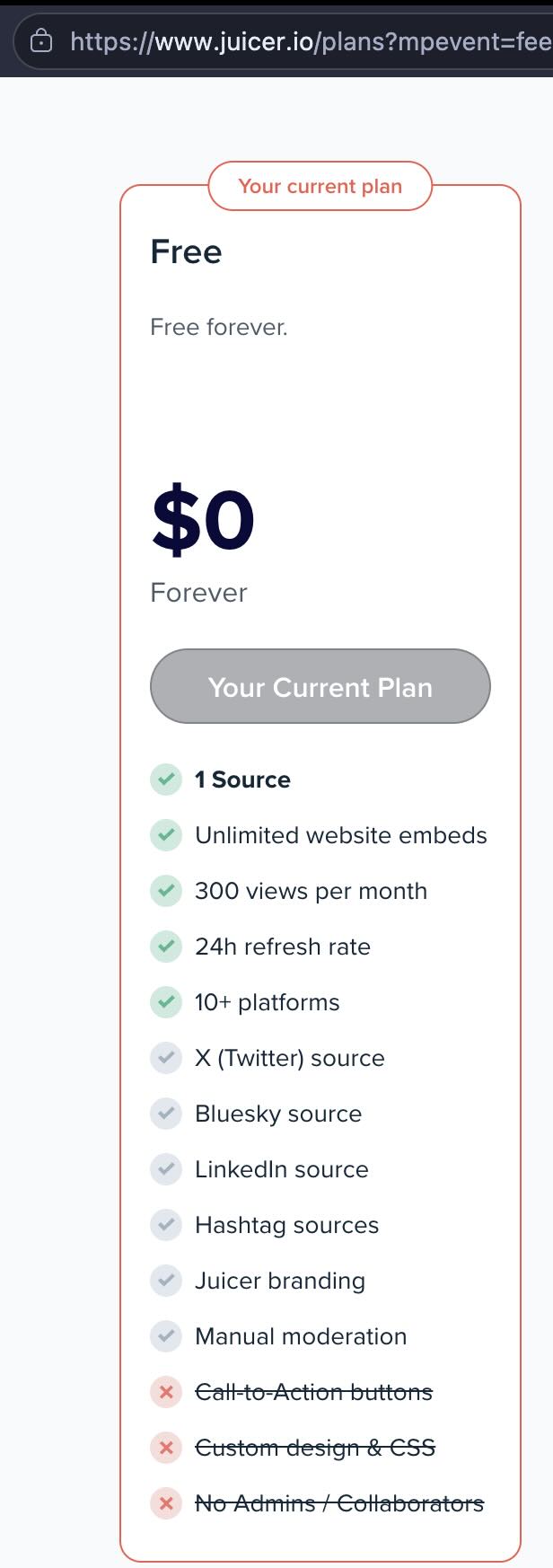
Two caveats, and they matter more than the finding. First, this is a dated observation from our own signup rather than a policy we can quote back to you. Second, and more useful: the pricing page does not show the restriction. The free-plan column in the screenshot above lists "X (Twitter) source" and "LinkedIn source" with no trial qualifier next to either one. That is precisely why it gets missed, and it is the reason to confirm both platforms with Juicer directly before you commit a B2B feed to either.
Juicer Pricing vs. Competitors: The Direct Comparison
| CollectSocials | Juicer | Curator.io | Taggbox | |
|---|---|---|---|---|
| Free plan | 1 source, unlimited feeds | 1 source, unlimited embeds | 3 sources, 1 feed | Trial only |
| Entry paid plan | $29/mo (5 sources) | ~$25/mo (5 sources) | $25/mo (5 sources) | ~$19/mo (2 feeds) |
| Mid-tier | $59/mo (15 sources, unlimited feeds) | $99/mo (30 sources, unlimited embeds) | $59/mo (15 sources) | ~$39/mo (4 feeds) |
| LinkedIn/X | X on every paid plan (and the free trial); LinkedIn not live | Enterprise only ($199/mo) | Included on all plans | Included on all plans |
| Multiple feeds | Unlimited on all plans | Unlimited embeds on all plans | Tied to sources | 2-3 on paid plans |
| Refresh rate (entry paid) | 60 minutes | 60 minutes | 60 minutes | 30 minutes |
| Live chat support | No (email only) | No (email only) | Yes | Yes |
The most striking comparison is the LinkedIn/X restriction. Curator.io, Taggbox, CollectSocials and most other competitors carry X on standard paid plans, and a CollectSocials account can connect X during its free trial before paying at all. Juicer's decision to gate it behind Enterprise creates a meaningful gap for B2B-focused brands.
The second row worth reading closely is monthly views, because it is the line most likely to force an upgrade you did not plan for. Every hosted plan in this table meters them, ours included: 300 a month on Juicer's free plan, 2,000 on ours, 30,000 on our Pro. The one exception is WordPress. Our WordPress plugin copies posts and the published design into your own WordPress database and renders from your domain, so once a feed has synced its page views are not metered on any plan, free included, however much traffic that page takes. The qualifier matters: before the first sync, and for any feed that cannot sync, the plugin falls back to fetching from us and those views meter like any embed.
Higher pricing
Limited sources
25% lower cost
Unlimited feeds
Is Juicer.io Worth It? An Honest Verdict by User Type
For personal bloggers and creators: The free plan is genuinely usable if you only need one social account and can tolerate daily refresh rates and Juicer's branding. The Lite plan at ~$15/month makes sense if removing the branding is important and daily updates are sufficient. Put the free tiers side by side before you settle, though: 300 monthly views is the tightest allowance in this comparison, against 2,000 views and unlimited feeds on the CollectSocials free plan, which is permanent rather than a trial and carries a small credit link instead of a branded overlay.
For small businesses (Instagram, Facebook, YouTube-focused): The Starter plan at ~$25/month works if your active channels are among the non-restricted platforms. While you get unlimited website embeds, all sources combine into one stream. CollectSocials' Pro plan at $29/month carries the same five sources and splits them into as many separate feeds as you want, with 30,000 page views and five UGC rights requests a month, each with a recorded consent trail, worth evaluating before committing to Juicer.
For B2B businesses or brands heavily using X/Twitter: if the restriction we saw still holds, Starter and Pro are not viable beyond the 7-day trial and you are looking at Enterprise at $199/month minimum, which is a steep entry point for two platforms. Most tools in this category carry X on standard paid plans. On our side X is on every paid plan and can be connected during the free trial before you pay anything; LinkedIn is not live yet, so if LinkedIn specifically is your primary channel, confirm it with whoever you shortlist.
For growing businesses that need 6-15 sources: There is no plan for you at Juicer. You jump directly from 5 sources at $25/month to 30 sources at $99/month. If you need 8 sources, you are paying $99/month whether you use the other 22 or not. This gap in the plan structure is one of the most common complaints from mid-market Juicer users. This is the band where a tier actually sized for it saves real money: CollectSocials Business is $59/month for 15 sources with unlimited separate feeds, which covers the whole 6-to-15 range for $40 a month less than Juicer's Pro, without paying for twenty-two sources you will not connect.
For agencies managing multiple clients: Enterprise at $199/month is the only option that includes white-label and API access. The usage-based billing model is fair but requires careful management of refresh rates to avoid unexpected overages. If you are billing clients at a markup and managing 10-plus separate social feeds, the Enterprise economics can work. For smaller agencies managing fewer clients, the $199 minimum may not be justified, and white-label alternatives at lower price points are worth evaluating.
For event organizers: a flat rate for a specific date range is a sensible model for occasional use, and Juicer sells one. Worth knowing that a free window can cover the same job: every CollectSocials team's first event runs free on a one-time 24-hour go-live window with no card, so a single event can run end to end before anyone pays, and after that the wall modes are part of the $59 Business plan. Price the two shapes against how many events you actually run.
The Bottom Line
Juicer.io is a long-established social media aggregator with a decade of development behind it. The product works, it ships a WordPress plugin, and support is email-only.
The pricing structure, however, has some structural gaps that matter depending on your situation. The jump from $25 to $99 with nothing in between leaves mid-market users either overpaying or underserved. The LinkedIn and X/Twitter restriction behind Enterprise pricing is a genuine blocker for B2B brands. And the Enterprise billing model, while fair, requires understanding before you sign up.
If your needs fit squarely within what Juicer's Lite or Starter plans deliver, a clean feed from two to five non-restricted platforms with hourly or daily refresh, it is a functional choice at a fair price. If you have needs that push you toward the gaps described above, it is worth exploring what the alternatives offer before committing.
For a detailed comparison of how Juicer stacks up against eight alternatives on design, pricing, and features, see the full Juicer.io alternatives guide.
Start Using CollectSocials Today
One curated feed from 10+ platforms: on your website in a single line of code, or up on the big screen at your event.