
But as your needs grow beyond the basics, Tagembed's limitations start to surface. The design templates are functional but not distinctive. Feed refresh rates on lower plans are slow: two hours on the Starter tier. AI moderation is locked behind the most expensive plan. Customization that should be intuitive requires workarounds or CSS knowledge. And the free plan's 500-view monthly cap means most business websites will outgrow it within days.
If you are evaluating Tagembed for the first time or running into its ceilings, this guide compares eight alternatives that address these specific shortcomings. We cover what each tool does best, where it falls short, and how pricing stacks up, so you can choose the right aggregator without paying for features you do not need or settling for design quality that does not match your website.
Unlike other "alternatives" articles, this one includes original test data: render-architecture findings, CSS isolation results, and dollar-per-source pricing math. (Full testing methodology is documented in our Instagram feed widget comparison. If you are still deciding whether you need a widget at all, start with how to embed an Instagram feed on your website.)
sync
How it works
What you're seeing: This animation shows posts escaping their platform silos (Instagram, Facebook, Google) and flowing automatically through a sync bridge to your website widget. Each post flies from the locked platform container, crosses the "auto sync" connection, and lands in your live website feed, all without manual intervention.
Tagembed's Starter plan refreshes feeds every two hours, which means a post you publish at 10 AM might not appear on your website until noon. Growth plan brings it down to thirty minutes, and fifteen-minute refresh rates only arrive on the most expensive Advance tier. This animation demonstrates what modern aggregation should be: connect once, then posts appear automatically with minimal delay. No copying embed codes. No two-hour refresh cycles. Just real-time content flow.
Why People Look for Tagembed Alternatives
Tagembed is a capable entry-level tool, but several recurring pain points push users toward alternatives. These are drawn from user reviews on G2, Capterra, and independent comparison sites, not hypothetical complaints.
Design quality does not match modern website standards. Tagembed offers basic layout options (grid, list, slider and a few variations), but the default templates lack the polish that businesses expect in 2026. If your website uses a clean, modern design system, Tagembed's widgets can look noticeably out of place. Achieving a more refined look typically requires custom CSS, which contradicts the platform's no-code positioning. Multiple reviewers on comparison sites note that Tagembed's customization options are not as beginner-friendly as advertised, creating a learning curve for non-technical users.
Slow feed refresh rates on affordable plans. Tagembed's Starter plan refreshes feeds every two hours. The Growth plan brings this down to thirty minutes. The fastest option, fifteen-minute refreshes, is exclusive to the most expensive Advance plan. If you are posting actively on social media and want your website to reflect that quickly, the lower-tier plans create a noticeable lag between what you post and what visitors see.
AI moderation is premium-only. Automated and AI-powered content moderation is only available on Tagembed's Advanced plan, which starts at a significantly higher price point. Starter-plan users are limited to manual moderation, which becomes time-consuming when managing multiple feeds or high-volume UGC campaigns. For businesses that aggregate hashtag content from their audience, the inability to auto-filter spam or off-brand posts without paying for the top tier is a real friction point.
Feature gating feels aggressive. Features like custom CSS, faster refresh rates, collaborator access, and advanced analytics are distributed across tiers in a way that multiple reviewers describe as opaque. Small businesses often find themselves needing to upgrade not because they need more sources, but because a single feature they need, like team collaboration or faster syncing, is locked behind a higher plan.
UGC rights management is not on the free plan.Requesting and recording permission to reuse a customer's photo does exist on the merged platform, on the Taggbox side, but you have to be paying for it, so anyone evaluating on the free tier is handling rights by hand or through a third-party tool. CollectSocials includes it on every plan, free included, at five requests a month on Free and Pro and uncapped from Business: you send the request, and the reply is written to an append-only evidence ledger you can show later. Our consent-and-deletion audit walks through what that record looks like after a creator withdraws consent.
Limited to website embedding. Unlike competitors that support event displays, digital signage, email newsletters, and app integrations from a single plan, Tagembed is primarily focused on website widgets. If your social content strategy extends beyond your website, you may outgrow Tagembed's scope quickly.
These limitations do not make Tagembed unusable. It remains a solid budget option for basic embedding. But they explain why a growing number of users seek alternatives that offer better design, smarter pricing, and fewer feature restrictions on lower tiers.
Why this matters for Tagembed users
20 minutes vs 2 minutes. The left side shows the manual embedding workflow: find each post on LinkedIn, copy the embed code, open your website editor, paste the code block, publish the page. Repeat five times for five posts. Total time: ~20 minutes. The exhaustion emoji gets progressively worse with each manual cycle.
The right side shows CollectSocials' automated approach: connect your account once (~2 minutes), then watch as posts flow in automatically. The bottom banner confirms the time savings: ~18 minutes saved for this batch alone, and every future update is free. Tagembed's feature gating means you're constantly navigating upgrade prompts and tier restrictions just to access basic functionality. This animation shows what happens when the tool gets out of your way.
We Tested Tagembed: Here Is What We Found
I installed Tagembed (which shares its technical infrastructure with Taggbox, its parent company) on a blank HTML test page, recorded how it renders and how many files it loads, and tested CSS isolation with deliberately aggressive stylesheets. (Full methodology documented in our Instagram feed widget comparison.)
Tagembed loads 22 separate JavaScript files, more than any widget I tested and 22 times what the CollectSocials embed loads. That is an architecture choice rather than a number that moves with your feed, so it is the same 22 files on every site running the widget.
How Each Widget Renders
| Widget | Render method | Files loaded | Style isolation |
|---|---|---|---|
| Tagembed / Taggbox | Script embed | 22 | None (iframe optional) |
| Flockler | Script embed | 2 | None (iframe optional) |
| Curator.io | Script embed | 4 | None |
| CollectSocials | Script embed | 1 | Shadow DOM |
| Juicer.io | Script embed | 2 | None |
CSS Isolation
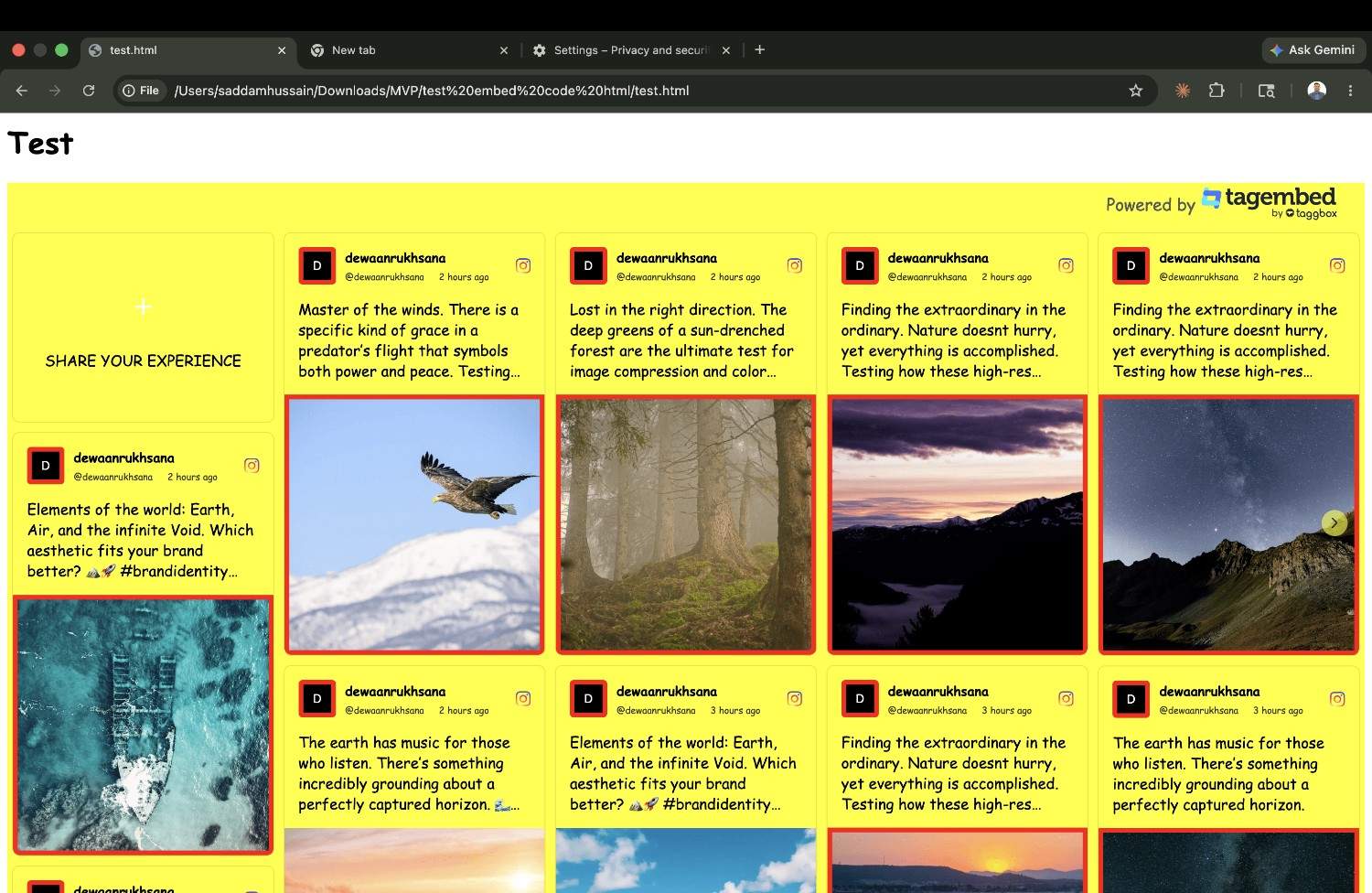
I tested CSS isolation by injecting aggressive styles. Tagembed's default script embed has zero CSS isolation. The iframe embed option provides full isolation.
| Widget | Isolation Method | Page CSS Breaks Widget? | Widget CSS Leaks Out? |
|---|---|---|---|
| CollectSocials | Shadow DOM (open) | No ✓ | No ✓ |
| Walls.io | Iframe | No ✓ | No ✓ |
| Flockler (iframe embed) | Iframe (optional) | No ✓ | No ✓ |
| Taggbox (iframe embed) | Iframe (optional) | No ✓ | No ✓ |
| EmbedSocial (direct iframe) | Iframe | No ✓ | No ✓ |
| EmbedSocial (JS embed) | Iframe (JS-injected) | During load only ✗ | Minor ✗ (wrapper div) |
| Flockler (default script) | None (global CSS) | Yes ✗ | Yes ✗ |
| Taggbox (default script) | None (global CSS) | Yes ✗ | Yes ✗ |
| Elfsight | None (global CSS) | Yes ✗ | Yes ✗ |
| Curator.io | None (global CSS) | Yes ✗ | Yes ✗ |
| Juicer.io (default script) | None (global CSS) | Yes ✗ | Yes ✗ |
| Juicer.io (iframe embed) | Iframe | No ✓ | No ✓ |
Dollar-Per-Source Pricing
| Tool | Plan | Sources | Price | $/Source |
|---|---|---|---|---|
| Tagembed | Starter | 2 | $19/mo | $9.50 |
| Tagembed | Growth | 4 | $39/mo | $9.75 |
| CollectSocials | Pro | 5 | $29/mo | $5.80 |
| CollectSocials | Business | 15 | $59/mo | $3.93 |
| Curator.io | Pro | 5 | $25/mo | $5.00 |
| Juicer.io | Starter | 5 | $25/mo | $5.00 |
1. CollectSocials: Modern Design and Generous Free Plan
Best for: Businesses that want premium design quality, unlimited feeds, and a price that does not climb every time they add a widget, without sacrificing customization or ease of use.
CollectSocials turns one curated feed of posts, reviews and video from ten live platforms into both a widget on your website and a full-screen wall the whole room can post to, with consent recorded and provable on every post. It supports Instagram, Facebook, YouTube, Google Reviews, TikTok, and X/Twitter (X/Twitter on paid plans), plus Pinterest, Vimeo, Tumblr, and RSS. LinkedIn is not live yet. The website half is the same job Tagembed does, and it is executed with higher design quality and a more generous pricing structure: where Tagembed gives you basic templates and asks you to write CSS to make them better, CollectSocials gives you professional results out of the box.
Where CollectSocials wins
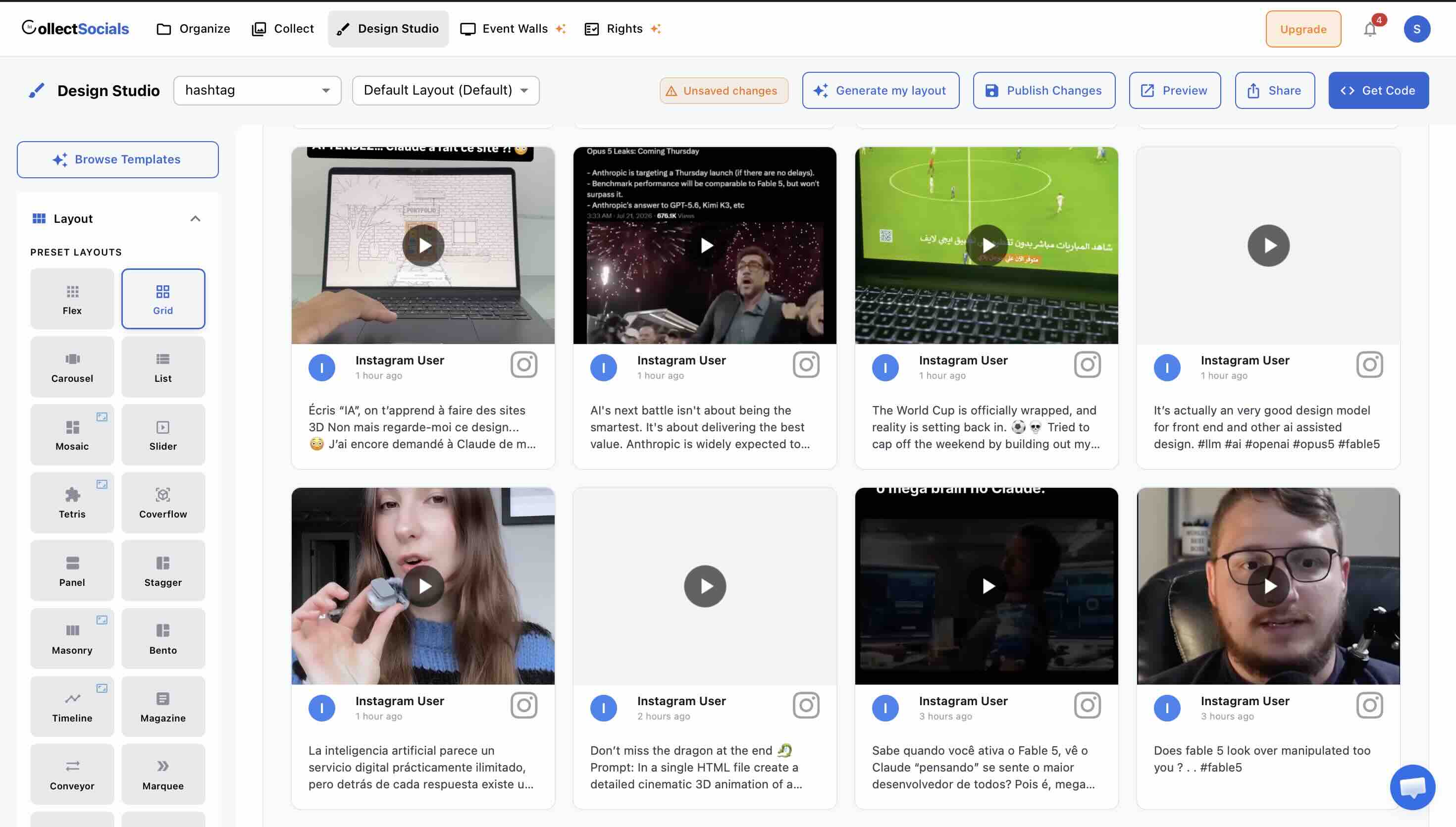
The design library is the single biggest upgrade over Tagembed. CollectSocials offers forty professionally designed layouts (Grid, Masonry, Carousel, List, Mosaic, Slider, Marquee, Compact, Tetris, Stack, Coverflow, Panel, Stagger and Layers among them) paired with sixteen themes including Minimal, Bold, Elegant, Glass, Neon, Brutalist and Midnight. Each combination is designed to look polished without any code. This is not a marginal improvement over Tagembed's layout options. It is a different category of design quality entirely.
What you're seeing
40 layouts × 16 themes = professional design without CSS. This animation mirrors CollectSocials' actual Design Studio interface. The left sidebar shows clickable layout options (Grid, Masonry, Carousel, List, Mosaic, Marquee) and theme swatches (Minimal, Bold, Glass, Elegant, Neon). The preview area on the right morphs through different combinations automatically, demonstrating how the feed transforms with each selection.
Tagembed's templates are functional but generic, multiple reviewers note they look dated compared to modern website designs. Achieving a polished result requires custom CSS, which contradicts the platform's no-code promise and creates a learning curve for non-technical users. This animation shows what happens when design is treated as a core feature: instant professional results without touching code. Each combination shown here is production-ready.
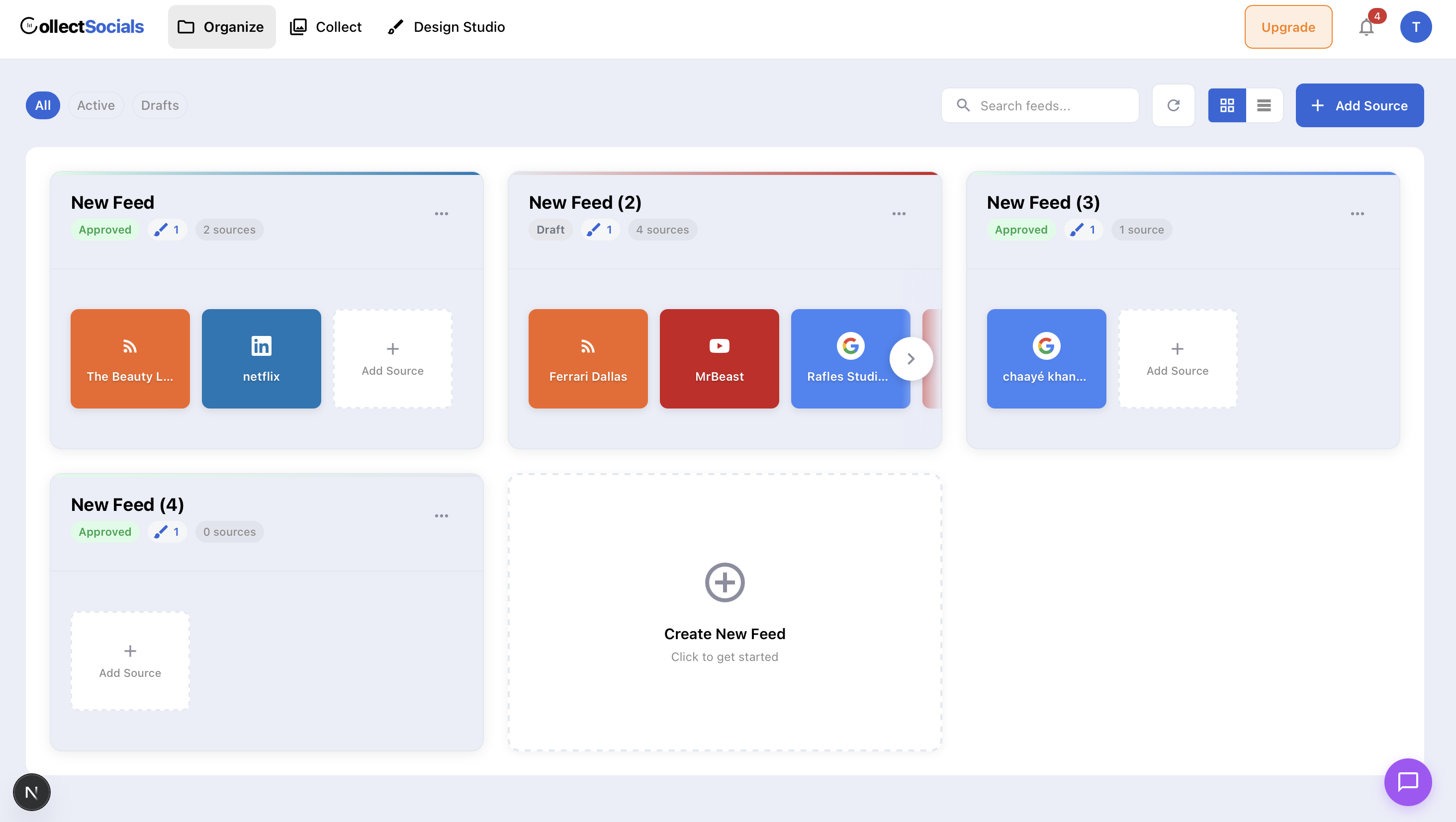
Unlimited feeds on every plan, including free. Tagembed restricts the number of widgets you can create based on your plan tier. CollectSocials takes the opposite approach: create as many feeds as you want on any plan, and only pay based on the number of sources you connect. This means you can have separate feeds for your homepage, portfolio page, testimonials section, and blog sidebar, all from the single source the free plan connects, without hitting an artificial ceiling. For a detailed walkthrough, see our guide on embedding social feeds on any website.
Multiple layouts per source eliminate redundant upgrades. On Tagembed, if you want to display the same Instagram content in a grid on one page and a carousel on another, you need separate widgets that may consume additional feed slots. On CollectSocials, you can apply different layouts and themes to the same source feeds freely. This single feature can prevent the need to upgrade to a more expensive plan just to reuse your own content in a different format.
What each tier includes is the comparison, not the sticker. CollectSocials' free plan includes one connected source, unlimited feeds, and 2,000 monthly page views, with three sources through the 7-day trial. The Pro plan at $29 per month gives you five sources, 30,000 page views, all 40 layouts, a separate mobile layout, and removes CollectSocials branding. Tagembed's paid plans start lower, at $19 for limited feeds on a two-hour refresh, and the feed count is what climbs from there. CollectSocials' Business plan at $59 per month includes fifteen sources, unlimited page views, and AI vision moderation, which on Tagembed is the $99 Advance plan. Several of the things a rival would charge for are missing from that upgrade list because they are not gated at all: keyword and profanity filters, all 16 themes and the theme builder, custom colours and fonts, and caption editing all run on the free plan. UGC rights and consent tracking runs on the free plan too, at five requests a month on Free and Pro and uncapped from Business, where Tagembed lists rights management as an Enterprise feature. Pinning a post to the top is the one curation control that is paid, and the 7-day trial includes it.
Shadow DOM isolation prevents style conflicts. The CollectSocials embed renders inside a Shadow DOM, meaning its CSS cannot interfere with your site's styles. This is particularly relevant for Tagembed users who have experienced layout issues when their site's CSS and Tagembed's widget styles conflict. It works on any platform: WordPress, Webflow, Squarespace, Wix, Shopify, or custom HTML. On WordPress there is also a plugin in the official directory, which syncs posts into your own database and renders them from your own domain: see the WordPress social feed plugin page.
The same feed also drives a live event wall. This is the part Tagembed has no answer to. On the $59 Business plan the feed you embed on your website opens full screen for a venue, in eleven wall modes rendered by the screen page itself, so the website widget never loads on the TV. Anyone in the room can scan the code on the screen and send a photo, a message or a question from their phone, with no login, no app and no social account, and the phone opens a camera booth with a three-second countdown and a front-or-back flip. Attendees vote in live multiple-choice polls from that same page, one vote per device, and the results render as animated bars on the big screen. A name and a consent tick are both required and both enforced on the server rather than just in the form, submissions land in a human review queue before anything reaches the display, and nobody signs into an account on the venue machine: the screen shows a pairing code that expires after fifteen minutes. The full breakdown is on our social wall for events page.
Why curation matters
Moderation should be simple, not premium-gated. This animation shows CollectSocials' curation interface in action. The left side displays imported posts flowing in from your connected accounts. As each post appears, you make a decision: green checkmark to approve (post slides right into "Live on Site"), or red X to reject (post fades away). The website preview on the right updates instantly with only approved content. The header tracks your decisions in real-time: "✓ 3 approved" and "✕ 2 hidden".
Tagembed gates AI-powered moderation behind its $99 Advance plan, forcing Starter users to manually review every post. For hashtag campaigns or high-volume feeds, this becomes time-consuming quickly. CollectSocials provides manual curation on every plan (shown here), keyword and profanity filters on every plan as well, and AI vision moderation from the $59 Business tier.
Where to keep in mind
Tagembed lists more source types than CollectSocials' ten live platforms, so if you need aggregation from a genuinely niche network, confirm CollectSocials covers it before you switch. LinkedIn is not live yet either. That said, for the platforms most businesses actually use (Instagram, Facebook, YouTube, Google Reviews), CollectSocials delivers a meaningfully better experience at a comparable or lower price.
Pricing
- Free ($0/mo): 1 source, unlimited feeds, 7 layouts, all 16 themes, 2,000 page views, plus a 7-day trial that opens 3 sources and the full design studio
- Pro ($29/mo): 5 sources, unlimited feeds, 30,000 page views
- Business ($59/mo): 15 sources, unlimited feeds, unlimited page views
- Annual billing is two months free: $290 a year on Pro, $590 on Business
CollectSocials' free plan includes one connected source, unlimited feeds, and 2,000 monthly page views with seven layouts and all 16 themes. Every new account starts with a 7-day trial that opens three sources and the full design studio, all 40 layouts plus the custom card builder, so you can design the whole widget before deciding. When the trial ends the oldest source stays live (X sources need a paid plan after the trial) and the rest pause with their posts kept. The Pro plan at $29 per month unlocks all 40 layouts, five sources, 30,000 page views, a separate mobile layout and theme, and removes CollectSocials branding. Keyword filters, the theme builder, custom colours and fonts and caption editing are not on that list because they are not gated: they are on the free plan too. UGC rights and consent tracking is on the free plan as well, at five requests a month on Free and Pro and uncapped from Business.
2. Curator.io: Best Free Plan for Source Variety
Best for: Businesses that need to aggregate from a large number of social platforms with a usable free tier and nearly invisible branding.
Curator.io is a social media aggregator with one of the longest source lists in the category: over a dozen, including Instagram, Facebook, YouTube, X/Twitter, TikTok, LinkedIn, Pinterest, Tumblr, and RSS. Its free plan includes three sources with minimal watermark branding, a small logo rather than Tagembed's more visible badge, making it one of the most professional free tiers in the category. For a deeper look, see our full Curator.io alternatives guide.
Where Curator.io works well
The platform breadth is the key differentiator. If you need to pull content from Tumblr, DeviantArt, or RSS feeds alongside your main social accounts, Curator.io likely supports it. The free plan is genuinely usable for small sites: three sources, minimal branding, straightforward setup. Paid plans start at $25 per month for the Professional tier with five sources and 15,000 page views, including custom CSS and content moderation. Its niche-network coverage reaches further than anything else on this list.
Where it falls short
Curator.io's design templates have not kept pace with what the category ships now. The default layouts are functional but feel dated compared to what CollectSocials offers out of the box. Like Tagembed, Curator.io ties each layout to its content source, meaning you need to add a source twice if you want to display it in different layouts on different pages, consuming extra source slots. The Business plan at $59 per month is priced level with CollectSocials' Business tier, which carries the same fifteen sources plus unlimited page views, AI vision moderation and a live event wall on the same account.
Pricing
Free: 3 sources, minimal branding, $0/mo. Professional: 5 sources, 15,000 views, $25/mo. Business: 15 sources, $59/mo. Enterprise: custom pricing.
3. Elfsight: Best Widget Marketplace for Non-Developers
Best for: Website owners who want a plug-and-play social feed widget from a marketplace of eighty-plus website tools, with per-app pricing that keeps costs low for single-widget use cases.
Elfsight takes a fundamentally different approach from Tagembed. Rather than being a standalone social media aggregator, it is a marketplace of over eighty website widgets, and its Social Feed widget is one of its most popular products. It supports Instagram, Facebook, YouTube, TikTok, X/Twitter, Pinterest, Tumblr, LinkedIn, and RSS, and embeds on any website platform through a single HTML code snippet managed through an online editor.
Where Elfsight works well
The per-app pricing structure makes Elfsight extremely affordable for single-widget needs. A Social Feed widget starts at $6 per month on the Basic plan with 5,000 views and three widgets, or $12 per month on Pro with 50,000 views and nine widgets. If you only need an Instagram feed on your homepage and nothing else, Elfsight can be cheaper than Tagembed. The visual configurator is genuinely code-free: five layouts (Grid, Masonry, List, Slider, Carousel) with dark and light mode, popup viewing, and auto-playing video. The cloud-based approach means no plugin installation on WordPress. G2 reviewers consistently praise its ease of use and responsive customer support.
Where it falls short
Elfsight is built as a widget marketplace, not a dedicated social aggregator. This means it lacks the content curation and feed management depth that purpose-built tools like CollectSocials or Curator.io provide. You cannot curate individual posts, manage multiple feeds from a central dashboard, or apply the same content across different layouts without creating separate widgets. View limits on lower plans can be restrictive: the free plan caps at just 200 views, and exceeding your monthly limit deactivates your widget entirely until the next billing cycle. If you need social aggregation as a core part of your marketing strategy rather than a simple one-off widget, Elfsight will feel limited.
Pricing
Free: 1 widget, 200 views/mo. Basic: 3 widgets, 5,000 views, $6/mo. Pro: 9 widgets, 50,000 views, $12/mo. Premium: 21 widgets, 150,000 views, $24/mo. All Apps Pack available for access to 80+ widgets.
4. EmbedSocial: Best for Review-Focused Social Proof
Best for: Local businesses that want Google Reviews, Facebook Reviews, and social media feeds combined in a single, professional widget. For a deeper comparison, see our complete EmbedSocial alternatives guide.
EmbedSocial sits at the intersection of social media aggregation and review management. It offers both EmbedFeed (social aggregation) and EmbedReviews (review widgets) as separate products, with approved API integrations with Google, Instagram, and TikTok. If you are a restaurant, medical practice, legal firm, or service business where Google star ratings directly influence customer decisions, EmbedSocial offers a depth of review functionality that Tagembed does not match. For more context on measuring your feed's performance, see our guide on social feed analytics that actually matter.
Where EmbedSocial works well
The review widget functionality is the standout. You can pull Google, Facebook, and Yelp reviews into polished, customizable widgets with features like filtering to show only five-star ratings, connecting multiple Google Business accounts into a single gallery, and AI-generated reply suggestions that speed up your review response workflow. The social feed product supports aggregation from major platforms with official API connections, ensuring reliable data. If your social proof is almost entirely customer reviews rather than social posts, that review-management depth is the mechanism worth paying a feed-first tool's premium for.
Where it falls short
EmbedSocial separates its social feed and review products, meaning you may need two subscriptions if you want both. The all-products bundle at $64 per month addresses this but is significantly more expensive than tools that include review and social functionality natively. The standalone social aggregator (EmbedFeed) starts at $29 per month for three sources and 5,000 page views, the same monthly price as CollectSocials' Pro plan, which provides five sources and 30,000 page views. If your primary need is social feed aggregation without deep review management, the value proposition weakens.
Pricing
Pro: 3 sources, 5K views, $29/mo. Pro Plus: 6 sources, 20K views, $49/mo. Premium: 15 sources, 100K views, $99/mo. All Products bundle: $64/mo.
5. Flockler: Best for Unlimited Layouts Across Multiple Properties
Best for: Organizations managing multiple websites, brands, or regional properties that need unlimited feed layouts from the same content sources under a single subscription.
Flockler's fundamental advantage is its pricing model: you pay for sources, not layouts or display instances. Once your social accounts are connected, you can create unlimited grids, carousels, slideshows, and walls, and display them across as many websites, email newsletters, digital screens, and intranets as you want, all under one plan. This is a structural difference from Tagembed, where each widget and each display format consumes plan resources.
Where Flockler works well
Multi-brand organizations, universities, and companies with multiple web properties get the most value. The tag-filtering feature lets you connect one Instagram account and then display filtered subsets of that content on different pages based on hashtags or keywords. Content is retained even when sources are disconnected, unlike Tagembed, where removing a source can affect associated content. A single plan covers websites, emails, digital signage, and events. AI moderation, UGC rights management, and responsive layouts for desktop and mobile are included. Support is available via email, live chat, and phone. The feed auto-updates every ten to fifteen minutes without manual intervention.
Where it falls short
Flockler is expensive. Pricing starts at $129 per month for Basic, $229 for Business, and $379 for Pro. There is no free plan, only a 14-day trial. For small businesses that just need a social feed on one website, this pricing is prohibitive. The interface has a learning curve that can overwhelm new users. If you need the unlimited-layouts model but cannot justify enterprise pricing, CollectSocials offers multiple layouts per source at a fraction of the cost.
Pricing
No free plan. 14-day trial. Basic: $129/mo. Business: $229/mo. Pro: $379/mo.
6. Juicer: Best Lightweight Option With Broad Platform Support
Best for: Users who want a simple, set-and-forget social feed aggregator with a recognizable brand and support for fifteen-plus platforms. For a deeper analysis, see our full Juicer.io alternatives guide.
Juicer is one of the more familiar names in social media aggregation and offers a straightforward value proposition: connect your social accounts, generate a feed, and embed it on your site. It supports fifteen-plus platforms and has a free plan that includes one source and one feed with Juicer branding, refreshing once every 24 hours. It is a familiar name in the space and offers a WordPress plugin alongside standard embed codes.
Where Juicer works well
Juicer is genuinely simple to use. The setup process is quick and the embed code works reliably. The range of supported social platforms is broad, including some that competitors skip. For users who just need something that works without fuss, Juicer delivers that baseline consistently. The Pro plan at $99 per month unlocks thirty sources, custom CSS, and faster refresh rates.
Where it falls short
Juicer shares many of the same design limitations as Tagembed. The nine built-in styles feel dated, and meaningful customization requires CSS on paid plans. The free plan is extremely restrictive: one source, one feed, 24-hour refresh, and prominent Juicer branding. The mid-tier pricing creates an awkward gap: the Starter plan at $25 per month for five sources is reasonable, but jumping to Pro at $99 for more sources is a steep increase with no intermediate option. Content is lost when sources are disconnected. Overall, Juicer is a viable Tagembed alternative if your priorities are simplicity and platform breadth, but the nine built-in styles are the ceiling on how the feed can look.
Pricing
Free: 1 source, 1 feed, branded, $0/mo. Lite: 3 sources, $15/mo. Starter: 5 sources, $25/mo. Pro: 30 sources, $99/mo.
7. Walls.io: Best for Live Events and Interactive Displays
Best for: Event marketers and enterprise teams that need premium live social walls with interactive audience engagement: polls, photo booths and direct content submissions. For a detailed comparison, see our Walls.io alternatives guide.
Walls.io supports fourteen social platforms, direct content uploads, live polls, photo booths and QR-code audience participation. Tagembed does not compete in this space, because it is focused on website embedding rather than live event displays. That is a limit of Tagembed specifically, not of website embedding: CollectSocials runs live polls, an in-browser camera booth, attendee posting with no account and QR pair-to-TV off the same feed it embeds on your site, on the $59 Business plan.
Where Walls.io works well
If your use case includes live events alongside website embedding, Walls.io's interactive features are the core product rather than an add-on: real-time polls, photo booths and QR-code audience participation. Moderation tools handle high-volume real-time content reliably, accessibility meets WCAG 2.1 guidelines, and the platform is built for mission-critical event displays where downtime is not an option. If you need branded photo-booth frames or stickers composited onto an attendee's own photo, emoji reactions, or a named integration with your event or signage platform, that is where it is ahead of the cheaper tools on this list, CollectSocials included.
Where it falls short
Plans start at $270 per month (or $215/mo billed annually). For website-only use cases, this is impossible to justify. Walls.io is not designed for review management or Google Reviews embedding. It belongs in this comparison only because some Tagembed users also manage event displays and may find Walls.io addresses that need better than trying to stretch Tagembed into event contexts.
Pricing
Plans start at $270/mo (or $215/mo billed annually with 20% savings). Event passes from $270 (one-time for 30 days). Enterprise pricing available.
8. Onstipe: Cheapest Entry Price and Event Day Passes
Best for: Organizations on the tightest budgets that want basic aggregation, or a one-off event display bought by the day rather than by the month. For a deeper comparison, see our complete Onstipe alternatives guide.
Onstipe is the price leader in this category. Subscriptions start around $8 per month and event day passes start at $29 per day, below anything else on this list. It covers nine platforms including Facebook, Instagram, X/Twitter, LinkedIn, YouTube, Vimeo, Flickr, Tumblr and RSS, with both website embedding and screen output. It was not part of the hands-on render testing above, so it carries no file count or isolation result here.
Where Onstipe works well
If cost is the constraint that decides this, Onstipe delivers working aggregation at the lowest entry price of any tool covered here. The day pass suits a single event where an ongoing subscription makes no sense, though it is worth comparing against a free option before buying one: every CollectSocials team's first event runs free on a one-time 24-hour go-live window, on a free account with no credit card. Combo plans cover website embedding and event displays in one subscription, and PayPal-only checkout makes it reachable in regions where card penetration is lower.
Where it falls short
The free plan carries ads inside your feed, 500 page views, Onstipe branding, and only Facebook and Instagram, which is more restrictive than Tagembed's. X/Twitter needs the Plus plan at around $25 per month, LinkedIn has no auto-updates on any plan, and there is no Google Reviews support at all, which rules it out for most local businesses. Refresh runs from 24 hours on free to 15 minutes at the top, templates are generic, and CSS and API access sit on higher tiers.
Pricing
Free: 2 sources (Facebook and Instagram only), 500 views, ads, $0/mo. Nano: 2 sources, 10K views, about $8/mo. Starter: 4 sources, about $15/mo. Plus: 6 sources with X/Twitter, about $25/mo. Economy: 10 sources, about $39/mo. Event day passes from $29/day.
Quick Comparison Table
| Tool | Free Plan | Starting Price | CSS Isolation | Best For |
|---|---|---|---|---|
| Tagembed | 500 views/mo | $19/mo | Iframe (optional) | Budget CMS integration |
| CollectSocials | 1 source, 7 layouts, all 16 themes (7-day full trial, 3 sources) | $29/mo | Shadow DOM ✓ | Website feed and a live event wall on one plan |
| Curator.io | 3 sources, minimal branding | $25/mo | None ✗ | Platform variety, lightweight |
| Elfsight | 1 widget, 200 views | $6/mo | None ✗ | Single-widget, lowest cost |
| EmbedSocial | Free (1 source, 500 views) | $29/mo | Iframe ✓ (JS embed: partial) | Review integration |
| Flockler | No free plan (14-day trial) | $129/mo | Iframe (optional) | Multi-brand, unlimited layouts |
| Juicer | 1 source, branded | $15/mo | Iframe (optional) | Broad platform support |
| Walls.io | 14-day trial only | $270/mo ($215 annual) | Iframe ✓ | Live events, digital signage |
| Onstipe | 2 sources (FB/IG), 500 views, ads | $8/mo | Not tested | Lowest entry price, event day passes |
How to Choose the Right Tagembed Alternative
The right tool depends on what specific Tagembed limitation is driving your search. Here is a decision framework based on the most common scenarios. If you are new to social media aggregation entirely, our complete aggregation guide for small businesses covers the fundamentals.
If you want significantly better design without writing CSS, consider CollectSocials. Forty layouts and sixteen themes produce professional results out of the box, no code required. Unlimited feeds on every tier, including free, eliminate the widget-count restrictions that Tagembed imposes. For most businesses this is a direct upgrade from Tagembed: same ease of use, dramatically better visual output, and comparable pricing with more generous limits. If you also run events, the same feed drives a full-screen venue wall with attendee posting and live polls on the $59 Business plan.
If you need the broadest platform support with a usable free plan, choose Curator.io. Three sources with minimal branding for free is hard to beat. It supports niche platforms that neither Tagembed nor CollectSocials cover. The design is not as modern, but the source breadth is real and the free tier is one of the few you can put on a production page.
If you only need one simple widget at the lowest possible cost, choose Elfsight. At $6 per month for a single social feed widget with 5,000 views, Elfsight is the cheapest paid option. The trade-off is that it is a widget tool, not a content management platform. Once your needs grow beyond a single feed, you will outgrow it.
If customer reviews are your primary social proof, choose EmbedSocial. Multi-location review galleries, five-star filtering and AI-drafted replies are review-management mechanics a feed-first tool does not carry. For local businesses where star ratings drive decisions, that specialization is what the premium buys. Just be prepared for split product pricing if you also need social feed aggregation, and note that CollectSocials carries Google Reviews as a first-class source on every plan.
If you manage multiple websites or brand properties, choose Flockler or CollectSocials. Both offer unlimited layouts from the same sources. Flockler is the enterprise choice with email, signage, and intranet support. CollectSocials delivers similar multi-layout capability for websites at a fraction of the cost.
If you need a platform Tagembed and CollectSocials both skip, check Juicer. Its list runs to fifteen-plus networks, wider than either, and the set-and-forget embed does what it says. Setup time is not the reason to pick it: connecting an account on CollectSocials takes about two minutes, and Juicer's free tier is one source on a 24-hour refresh with its branding inside your feed. Go to Juicer for the source list, not for the design.
The Bottom Line
Tagembed found its market by being affordable and accessible, and for basic social feed embedding, it still serves that role. But our testing reveals a problem that Tagembed's marketing does not mention: 22 separate JavaScript files arriving into unreserved space, so the page reflows as they land, and zero CSS isolation on the default embed. At $9.50 per source with no volume discount, the "budget" positioning only holds for single-source use cases.
The bar for what a social feed should look like and how it should perform on a professional website has risen substantially. Visitors expect embedded social content to match the design quality of the rest of your site. They expect it to load fast, update quickly, and not tank their Core Web Vitals scores.
For most businesses looking to upgrade from Tagembed, CollectSocials offers a direct improvement: one script file instead of twenty-two, native Shadow DOM isolation, better design, more generous plan limits, and comparable pricing at $4.00 per source versus $9.50. The same curated feed also opens full screen for a venue on the Business plan, with attendee posting, live polls and QR pair-to-TV, so an event screen is not a second product. Set up a free feed in under five minutes and see the difference for yourself.
Start Using CollectSocials Today
One curated feed from 10+ platforms: on your website in a single line of code, or up on the big screen at your event.